
Benign prostatic hyperplasia (BPH), commonly called an enlarged prostate, becomes increasingly common with age. It can cause bothersome urinary symptoms such as frequent urination, weak urine flow, difficulty starting urination, urgency, nighttime urination, and incomplete bladder emptying. While medicines and conventional surgery remain important treatment options, minimally inva sive procedures have expanded the choices available to appropriately selected patients.
Prostatic Artery Embolization: How It Works is an important question for men considering a treatment that does not involve cutting or removing prostate tissue. Prostatic Artery Embolization (PAE) is a minimally invasive, image-guided procedure performed by an interventional radiologist. It works by selectively reducing blood flow to the prostate, allowing the enlarged tissue to gradually shrink and relieving pressure on the urethra. Current professional guidance recognizes PAE as a treatment option for selected men with BPH-related lower urinary tract symptoms.
Understanding BPH: Symptoms, Causes and Diagnosis
Symptoms of an Enlarged Prostate
BPH is a non-cancerous enlargement of the prostate. As the gland enlarges, it can narrow the urethra and interfere with normal urine flow.
Common symptoms include:
- Weak or slow urine stream
- Difficulty starting urination
- Frequent urination during the day
- Waking several times at night to urinate
- Sudden urinary urgency
- Intermittent urine flow
- Feeling that the bladder has not completely emptied
- Dribbling after urination
- Urinary retention in more advanced cases
The severity of symptoms varies from person to person. Having significant urinary symptoms does not automatically mean that a patient needs a procedure. A proper assessment is necessary before selecting treatment.
Causes of BPH
The exact mechanism behind prostate enlargement is complex, but aging and hormonal changes are strongly associated with BPH. The prostate can gradually increase in size as men get older, and the resulting enlargement may affect the bladder and urethra.
BPH is different from prostate cancer. However, urinary symptoms can have several possible causes, so persistent or worsening symptoms should be medically evaluated rather than automatically attributed to BPH.
Diagnosis Before PAE
Before recommending Prostatic Artery Embolization: How It Works, a specialist evaluates whether BPH is actually responsible for the symptoms and whether PAE is appropriate.
Evaluation may include:
- Medical history and symptom assessment
- Physical examination
- Urine testing
- Prostate-specific antigen (PSA) testing when clinically appropriate
- Ultrasound or other prostate imaging
- Measurement of post-void residual urine
- Uroflowmetry in selected patients
- Assessment of prostate size and anatomy
- Review of previous BPH medications and treatments
A detailed evaluation is important because treatment should be individualized according to prostate anatomy, urinary symptoms, overall health, and patient preferences. The 2026 American Urological Association guideline emphasizes shared decision-making when selecting procedural treatment for BPH.
Prostatic Artery Embolization: How It Works
What Is Prostatic Artery Embolization?
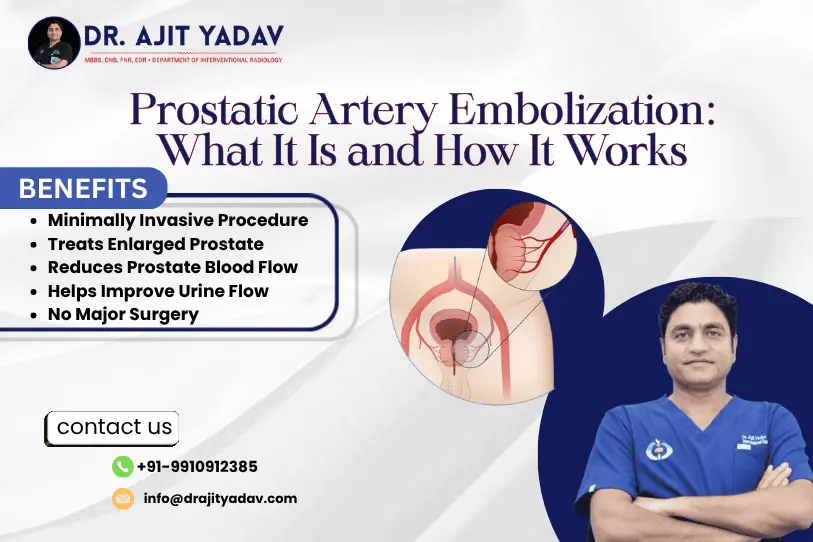
Prostatic Artery Embolization: How It Works can be understood through its blood-supply principle. The prostate receives blood through small arteries known as prostatic arteries. During PAE, an interventional radiologist guides a very small catheter into these arteries using advanced imaging.
Tiny embolic particles are then carefully delivered to reduce blood flow to targeted areas of the prostate. Over time, the treated tissue undergoes shrinkage. As prostate volume and tissue pressure decrease, the obstruction around the urethra can improve, helping urine pass more easily.
PAE does not involve surgically removing the prostate. It is therefore considered a minimally invasive approach rather than conventional prostate surgery. The procedure has gained increasing acceptance, and the Society of Interventional Radiology published updated practice guidance in 2026 based on evidence through 2025.
How the Procedure Is Performed
The exact technique depends on the patient’s anatomy and the interventional radiologist’s approach, but the procedure generally involves:
- Preparation: The patient undergoes pre-procedure assessment and appropriate imaging or laboratory testing.
- Local anesthesia: Local anesthesia is generally used, with sedation when appropriate.
- Arterial access: A small catheter is introduced through an artery, commonly through the wrist or groin.
- Imaging guidance: Fluoroscopy and angiography are used to identify the prostatic arteries.
- Selective catheterization: The catheter is carefully advanced into the appropriate prostatic arterial branches.
- Embolization: Tiny particles are injected to reduce blood flow to the enlarged prostate tissue.
- Completion: The catheter is removed and the access site is managed.
- Observation: The patient is monitored before discharge or overnight observation, depending on individual circumstances.
The procedure is technically demanding because pelvic arterial anatomy can vary between patients. Accurate imaging and careful catheter placement are essential to reduce the possibility of embolization affecting unintended tissues.
Who May Be Considered for PAE?
PAE may be considered for men with symptomatic BPH when medications have not provided adequate relief, when conventional surgery is undesirable, or when individual medical circumstances make a minimally invasive approach attractive.
However, PAE is not automatically suitable for every patient with an enlarged prostate. A specialist should assess prostate anatomy, urinary function, existing medical conditions, previous treatments, and expectations before recommending it.
Benefits and Possible Risks
Potential benefits of PAE include:
- Minimally invasive treatment
- No surgical removal of prostate tissue
- Usually performed without general anesthesia
- Potentially shorter recovery than conventional surgery
- Can be considered for appropriately selected patients who prefer to avoid surgery
- Improvement in urinary symptoms and quality of life
- Low risk of major bleeding in appropriately performed procedures
Evidence from randomized studies suggests that PAE can provide meaningful improvement in patient-reported urinary symptoms and quality of life, although some objective measures, such as maximum urinary flow and prostate-volume reduction, may improve more after TURP.
Like every medical procedure, PAE also has potential risks. These can include temporary pelvic discomfort, urinary symptoms, blood in the urine or semen, infection, vascular complications, or non-target embolization. Rare but serious complications are possible. Your doctor should explain the individual risks before treatment.
Treatment, Recovery and Comparison With Surgery
Recovery After PAE
Prostatic Artery Embolization: How It Works also explains why recovery can be different from conventional prostate surgery. Since PAE does not require an incision into the prostate or removal of prostate tissue, recovery is often relatively quick.
Some patients experience temporary symptoms after the procedure, including:
- Pelvic discomfort
- Mild burning during urination
- Increased urinary frequency
- Fatigue
- Blood-tinged urine or semen
These symptoms usually settle as the prostate responds to treatment. Improvement in urinary symptoms is generally gradual rather than immediate because the prostate needs time to shrink.
Patients should follow their specialist’s instructions regarding medications, hydration, activity, and follow-up appointments.
PAE vs TURP
PAE and transurethral resection of the prostate (TURP) work differently.
| Feature | PAE | TURP |
| Approach | Image-guided embolization | Endoscopic surgery |
| Prostate tissue | Not surgically removed | Prostate tissue is resected |
| Anesthesia | Often local with sedation | Usually regional or general |
| Recovery | Generally shorter | Generally longer |
| Urinary improvement | Significant in appropriate patients | Typically strong and predictable |
| Sexual considerations | Often attractive to patients wishing to preserve sexual function | Sexual side effects can occur |
| Best choice | Depends on anatomy and patient factors | Depends on anatomy and clinical factors |
Neither treatment is universally “better.” TURP has a long-established role and can provide strong improvements in urinary flow and obstruction. PAE offers a minimally invasive alternative that may be particularly attractive to selected patients who wish to avoid conventional surgery.
Current guidelines emphasize matching the treatment to the patient’s symptoms, prostate characteristics, risks, preferences, and expectations rather than choosing a single procedure for everyone.
Non-Surgical Prostate Treatment With Expert Interventional Radiology
Non-Surgical Prostate Treatment is an increasingly relevant search for men who want to understand options beyond conventional surgery. PAE is one such option, but “non-surgical” does not mean risk-free or appropriate for everyone.
Dr. Ajit Yadav’s PAE Treatment Information
Dr. Ajit Yadav is a Senior Consultant in Interventional Radiology at Sir Ganga Ram Hospital, New Delhi. His clinical interests include PAE for BPH, uterine artery embolization, thyroid nodule ablation, varicocele embolization, liver and tumor interventions, and other minimally invasive interventional radiology procedures.
His PAE service focuses on image-guided treatment for men with symptomatic enlarged prostate who are looking for a minimally invasive alternative to conventional prostate surgery.
Frequently Asked Questions
1. What is Prostatic Artery Embolization?
Prostatic Artery Embolization is a minimally invasive procedure used to treat urinary symptoms associated with benign prostatic hyperplasia. It reduces blood flow to selected areas of the prostate, allowing the gland to gradually shrink.
2. How does PAE reduce prostate symptoms?
Prostatic Artery Embolization: How It Works is based on reducing blood flow to enlarged prostate tissue. As the treated tissue shrinks over time, pressure around the urethra may decrease, improving urinary flow and other BPH symptoms.
3. Is PAE a replacement for prostate surgery?
PAE can be an alternative for appropriately selected patients, but it is not a universal replacement for surgery. Treatment should be selected after discussing the patient’s prostate anatomy, symptoms, medical history, and goals.
4. Is PAE painful?
PAE is generally performed using local anesthesia, sometimes combined with sedation. Temporary pelvic discomfort or urinary irritation may occur after the procedure, but the experience varies between patients.
5. How quickly will I notice improvement after PAE?
Improvement is usually gradual. Some patients notice changes within the first few weeks, while further improvement can occur over subsequent months as the prostate responds to reduced blood flow.
6. Does PAE require general anesthesia?
Not usually. PAE can generally be performed under local anesthesia with or without sedation, depending on the patient and clinical circumstances.
7. Can PAE affect sexual function?
One reason some patients consider PAE is its potential sexual-function profile compared with certain surgical procedures. However, individual outcomes vary, and no treatment should be presented as completely free of sexual side effects.
8. Is PAE suitable for every enlarged prostate?
No. Patient selection is important. A specialist should evaluate symptoms, prostate anatomy, vascular anatomy, urinary function, previous treatments, and other health factors before recommending PAE.
9. How long does recovery take after PAE?
Many patients can return to routine activities relatively quickly, but the exact recovery period varies. Your interventional radiologist will provide individualized instructions based on the procedure and your overall health.
10. Who performs Prostatic Artery Embolization?
PAE is performed by an appropriately trained interventional radiologist, often in coordination with urology when needed. The procedure requires specialized imaging equipment and expertise in pelvic vascular anatomy.
Conclusion
Prostatic Artery Embolization: How It Works is important for men exploring modern treatment options for BPH. PAE uses image-guided catheterization and tiny embolic particles to reduce blood flow to enlarged prostate tissue, allowing the gland to gradually shrink and potentially improving urinary symptoms.
It offers a minimally invasive approach without surgically removing prostate tissue and may be appropriate for carefully selected patients. At the same time, it is not suitable for everyone, and treatment decisions should be based on a complete medical evaluation and shared decision-making. Recent 2026 guidance from both interventional radiology and urology literature reflects the growing role of PAE among available BPH treatment options.
If urinary symptoms are affecting sleep, work, travel, or quality of life, don’t ignore them or assume that surgery is your only option.
Book an appointment with Dr. Ajit Yadav, Senior Consultant, Department of Interventional Radiology, Sir Ganga Ram Hospital, New Delhi, to discuss whether Prostatic Artery Embolization or another treatment option may be appropriate for you. His interventional radiology services also include PAE for BPH, thyroid ablation, varicocele embolization, uterine artery embolization, liver and tumor interventions, and other image-guided minimally invasive procedures.

Comments are closed