
The thyroid is a small, butterfly-shaped gland in the front of the neck, but the hormones it produces influence metabolism, heart function, temperature regulation, digestion, muscles, and many other body processes. When thyroid hormone production becomes too low or too high, women may experience symptoms that are easy to confuse with stress, aging, hormonal changes, pregnancy, or other health conditions.
Recognizing the Warning Signs of Thyroid Problems in Women can encourage timely evaluation and appropriate treatment. Thyroid disorders may include hypothyroidism, hyperthyroidism, thyroiditis, goiter, thyroid nodules, and, less commonly, thyroid cancer. Women are affected by thyroid disorders more often than men, making awareness particularly important.
This guide explains the Warning Signs of Thyroid Problems in Women, common causes, diagnosis, treatment options, recovery considerations, and when professional medical evaluation may be appropriate.
Symptoms, Causes and Early Warning Signs
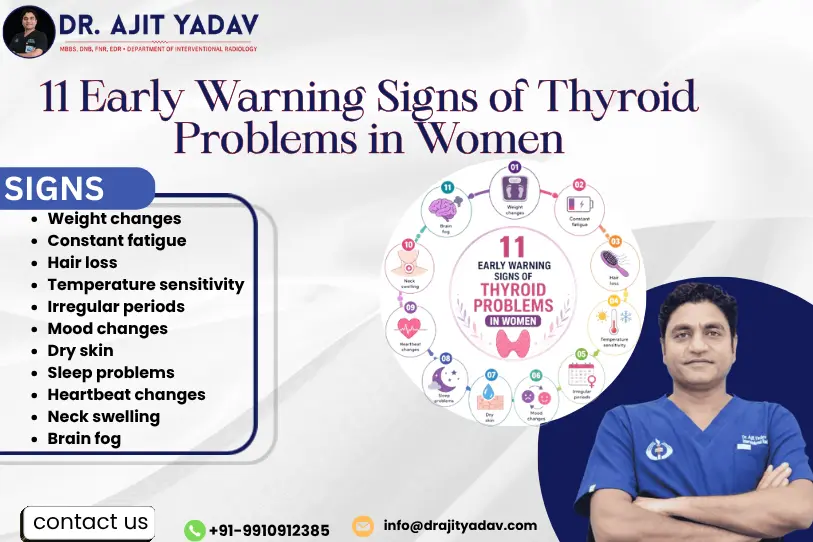
11 early warning signs to watch for
The Warning Signs of Thyroid Problems in Women can vary depending on whether the thyroid is underactive or overactive. Symptoms may also develop gradually, which means they can go unnoticed for months.
- Unexplained weight gain or weight loss
Unexpected weight gain can occur with hypothyroidism because metabolism slows down. Conversely, hyperthyroidism may cause weight loss despite a normal or increased appetite. Weight changes alone, however, do not confirm thyroid disease. - Persistent fatigue or unusual weakness
Feeling tired despite adequate sleep may be associated with an underactive thyroid. Hyperthyroidism can also cause fatigue because the body remains in an accelerated metabolic state. - Feeling unusually cold or hot
Women with hypothyroidism may feel colder than people around them, while hyperthyroidism can cause heat intolerance, increased sweating, or a persistent feeling of warmth. - Changes in menstrual periods
Thyroid dysfunction can affect menstrual cycles. Hypothyroidism may contribute to heavier or irregular periods, whereas hyperthyroidism may cause lighter or less frequent periods. Thyroid problems can also affect fertility. - Hair thinning and dry skin
Dry, coarse skin and thinning or dry hair can occur with hypothyroidism. Hair changes may have many other causes, so persistent symptoms should be evaluated rather than automatically attributed to the thyroid. - Constipation or more frequent bowel movements
A slower metabolism can contribute to constipation in hypothyroidism. Hyperthyroidism may instead cause more frequent bowel movements or diarrhea. - Fast or irregular heartbeat
A racing, pounding, or irregular heartbeat can be associated with excess thyroid hormone. This symptom deserves medical attention, particularly if it is persistent or accompanied by chest discomfort, fainting, or breathlessness. - Anxiety, irritability, or sleep problems
An overactive thyroid may cause nervousness, irritability, anxiety, tremors, or difficulty sleeping. Hypothyroidism can be associated with low mood, sluggishness, or difficulty concentrating. - Neck swelling or a noticeable lump
An enlarged thyroid, known as a goiter, or a thyroid nodule may produce visible or palpable swelling in the neck. A new lump should be assessed because thyroid nodules can be benign but sometimes require further investigation. - Muscle aches or weakness
Muscle aches, reduced exercise tolerance, or weakness may occur with thyroid dysfunction. These symptoms are nonspecific, so appropriate testing is important before assuming the thyroid is responsible. - Changes around the eyes
Some women with hyperthyroidism, particularly Graves’ disease, can develop eye symptoms such as irritation, redness, or bulging eyes.
What causes thyroid problems in women?
Common causes include autoimmune conditions. Hashimoto’s disease is a major cause of hypothyroidism, while Graves’ disease is the most common cause of hyperthyroidism. Thyroiditis, certain medications, previous thyroid treatment, radiation exposure, and thyroid nodules can also contribute to thyroid dysfunction.
Pregnancy and the postpartum period are also important times for thyroid monitoring because thyroid disorders can occur during or after pregnancy.
A thyroid nodule is different from a generalized thyroid hormone problem. Some nodules produce excess thyroid hormone, while many do not affect hormone levels at all. Most thyroid nodules are benign, but appropriate evaluation is important to determine their nature.
Diagnosis, Treatment and Procedures
How are thyroid problems diagnosed?
The Warning Signs of Thyroid Problems in Women can overlap with many other conditions, so symptoms alone cannot establish a diagnosis. A healthcare professional may review medical and family history, perform a physical examination, and order thyroid blood tests.
The TSH (thyroid-stimulating hormone) test is commonly used to assess thyroid function. Depending on the result and clinical situation, tests such as free T4, T3, or thyroid antibody testing may be recommended.
When a thyroid nodule or enlargement is suspected, an ultrasound can provide detailed information about the thyroid. Some nodules may require fine-needle aspiration or another evaluation to determine whether they are benign or malignant.
Treatment depends on the thyroid condition
Treatment is individualized according to the underlying diagnosis.
Hypothyroidism:
The usual treatment is thyroid hormone replacement, most commonly levothyroxine. The dose is adjusted according to thyroid function tests and the patient’s clinical situation.
Hyperthyroidism:
Treatment can include antithyroid medicines, radioactive iodine, or surgery depending on the cause, severity, patient characteristics, pregnancy status, and other factors.
Thyroid nodules:
Nodule management depends on its size, ultrasound appearance, symptoms, hormone activity, and cancer risk. Observation, biopsy, surgery, or selected minimally invasive treatments may be appropriate depending on the individual case.
Thyroid nodule ablation
For appropriately selected benign thyroid nodules, minimally invasive ablation may be considered. Thyroid nodule ablation uses image guidance to treat targeted nodule tissue while avoiding conventional open surgery in suitable patients.
Dr. Ajit Yadav is a consultant Interventional Radiologist at Sir Ganga Ram Hospital, New Delhi, with clinical interests that include ablation for thyroid nodules, uterine artery embolization, prostatic artery embolization, bronchial artery embolization, and minimally invasive oncologic interventions such as transarterial chemoembolization, radioembolization, and radiofrequency tumor ablation.
Learn about Dr. Ajit Yadav and Interventional Radiology services
It is important to understand that thyroid nodule ablation is not a universal treatment for every thyroid disorder. Women with abnormal thyroid hormone levels, suspicious nodules, or possible thyroid cancer require an appropriate diagnostic evaluation before any procedure is considered.
Benefits of minimally invasive thyroid nodule treatment
When a patient is an appropriate candidate, minimally invasive nodule ablation may offer advantages such as:
- No large neck incision
- Targeted treatment of the selected nodule
- Potentially less tissue disruption than conventional surgery
- Generally limited recovery requirements
- Preservation of the remaining thyroid tissue in suitable cases
- Treatment planning based on ultrasound and clinical findings
The expected benefits depend on the type, size, location, and characteristics of the nodule and the patient’s overall health.
Recovery, Comparison and FAQs
What is recovery like?
Recovery varies according to the treatment performed. Women taking thyroid hormone medication usually require ongoing monitoring rather than a procedure-based recovery period. After thyroid nodule ablation, recovery depends on the specific technique and individual circumstances.
Patients may be advised to follow post-procedure instructions, attend follow-up appointments, and undergo imaging or laboratory monitoring when recommended. The purpose of follow-up is to assess symptom improvement, thyroid function, and changes in the treated nodule.
Medication, ablation or surgery: how do they compare?
There is no single best thyroid treatment for every woman.
| Approach | Common use | Key consideration |
| Medication | Hypothyroidism or selected hyperthyroidism cases | Requires appropriate dosing and monitoring |
| Minimally invasive ablation | Selected benign thyroid nodules | Patient and nodule must meet suitability criteria |
| Surgery | Selected nodules, cancers, large goiters, or specific thyroid conditions | Removes part or all of the thyroid depending on the procedure |
| Observation | Selected low-risk nodules or mild conditions | Requires appropriate medical follow-up |
The correct option should be selected after diagnosis rather than based only on symptoms.
Frequently Asked Questions
1. What are the most common Warning Signs of Thyroid Problems in Women?
Common symptoms include unexplained weight changes, fatigue, temperature sensitivity, menstrual changes, hair or skin changes, constipation or frequent bowel movements, changes in heart rate, mood changes, and neck swelling. Symptoms vary according to the specific thyroid disorder.
2. Can thyroid problems affect periods?
Yes. Both hypothyroidism and hyperthyroidism can affect menstrual patterns. Changes may include heavier, lighter, irregular, or less frequent periods. Thyroid dysfunction can also affect fertility.
3. Can thyroid problems cause weight gain?
Yes. Hypothyroidism can contribute to weight gain, while hyperthyroidism more commonly causes weight loss. However, weight change has many possible causes and should not be used alone to diagnose thyroid disease.
4. What test confirms a thyroid problem?
TSH is commonly used as an initial thyroid function test. Depending on the results, doctors may order free T4, T3, thyroid antibodies, ultrasound, or other investigations.
5. Is every thyroid nodule cancerous?
No. Many thyroid nodules are benign. However, a new or enlarging nodule should be appropriately evaluated, often with ultrasound and, when indicated, fine-needle aspiration.
6. Can thyroid nodules be treated without surgery?
Some benign thyroid nodules can be treated with minimally invasive ablation when the patient and nodule are suitable. However, ablation is not appropriate for every nodule, and proper evaluation is essential before treatment.
7. Does thyroid nodule ablation treat hypothyroidism?
Not usually. Thyroid nodule ablation is designed to treat selected thyroid nodules. Hypothyroidism is generally managed with thyroid hormone replacement when treatment is indicated.
8. Can thyroid problems develop after pregnancy?
Yes. Thyroid disorders, including postpartum thyroiditis, can occur during the postpartum period. Symptoms such as fatigue, mood changes, or changes in weight should be discussed with a healthcare professional when persistent or concerning.
9. When should a woman see a doctor about thyroid symptoms?
Persistent unexplained symptoms, a new neck lump, significant menstrual changes, unexplained weight changes, or symptoms such as a racing heartbeat should prompt medical evaluation. Urgent medical care is appropriate for severe symptoms such as chest pain, fainting, severe breathing difficulty, or a very rapid or irregular heartbeat.
About Dr. Ajit Yadav and his services
Dr. Ajit Yadav, MBBS, DNB, FVIR, EBIR, is a Consultant in Interventional Radiology at Sir Ganga Ram Hospital, New Delhi. His clinical interests include minimally invasive image-guided procedures for several conditions. His listed areas of expertise include thyroid nodule ablation, uterine artery embolization for uterine fibroids and postpartum hemorrhage, prostatic artery embolization for BPH, bronchial artery embolization for hemoptysis, and minimally invasive cancer interventions including TACE, radioembolization, and radiofrequency tumor ablation.
For women concerned about a thyroid nodule, consultation with an appropriately qualified specialist can help determine whether observation, biopsy, medication, minimally invasive treatment, or surgery is appropriate.
Conclusion
The Warning Signs of Thyroid Problems in Women can be subtle, and symptoms such as tiredness, weight changes, hair loss, menstrual irregularities, temperature sensitivity, mood changes, or neck swelling may have several possible causes. Because thyroid disease cannot be reliably diagnosed from symptoms alone, appropriate blood tests and, when needed, imaging are important.
Early evaluation can help identify hypothyroidism, hyperthyroidism, thyroiditis, thyroid nodules, and other thyroid conditions before they cause avoidable complications. For women who have a thyroid nodule, treatment should be based on a careful assessment of the nodule and the individual’s medical needs.
If you have persistent thyroid-related symptoms or have been diagnosed with a thyroid nodule, consult a qualified specialist for personalized evaluation. To discuss minimally invasive options such as thyroid nodule ablation, book an appointment with Dr. Ajit Yadav, Interventional Radiologist, New Delhi.

Comments are closed